
What Monthly Bank Reconciliation Actually Involves
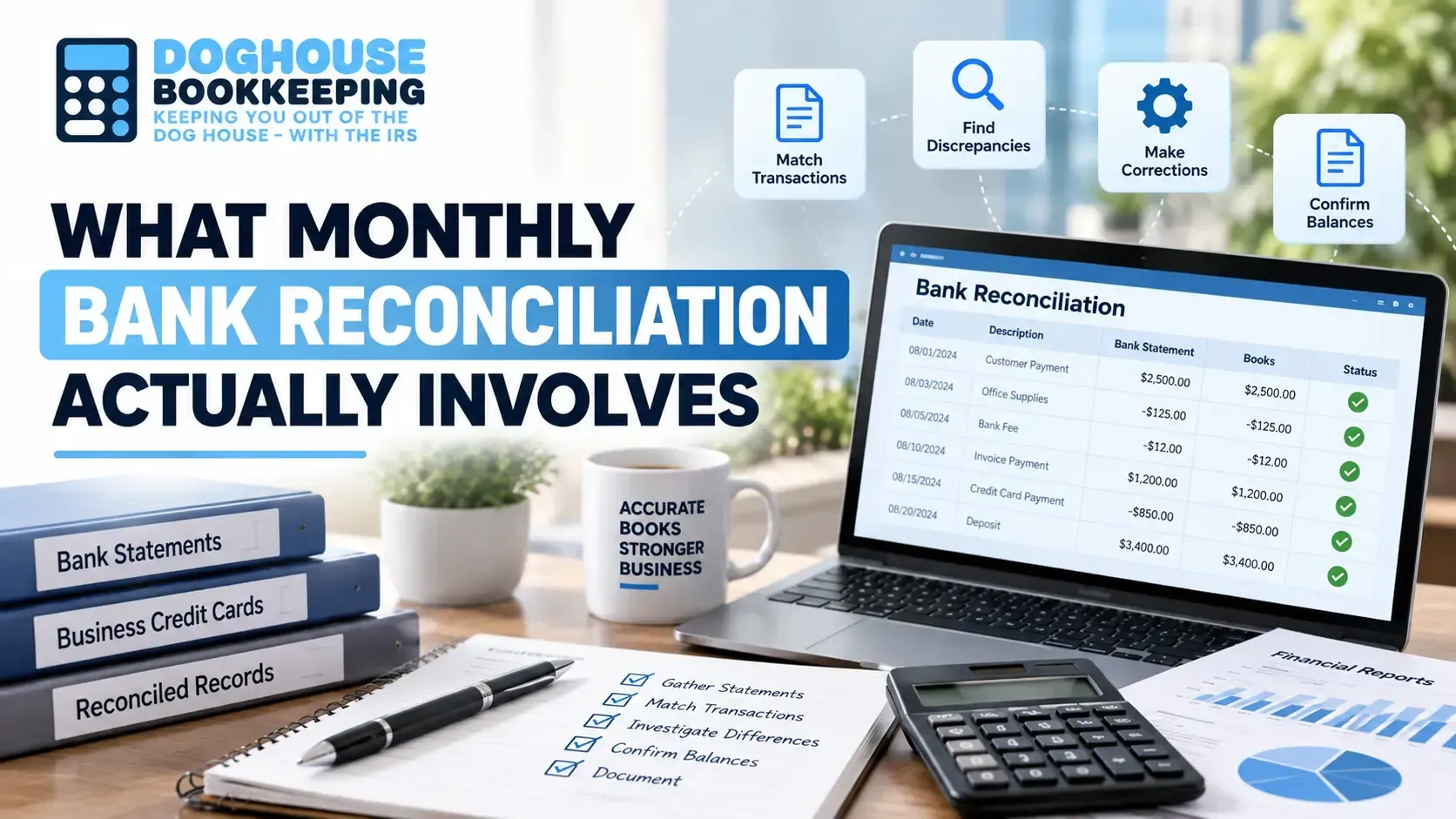
Monthly bank reconciliation involves comparing the transactions recorded in your bank and credit card statements with your bookkeeping records, identifying discrepancies, making necessary corrections, and confirming that the ending balance agrees with the statement, investigating and correcting anything that doesn't match, flagging bank fees or errors, and confirming your ending balance is accurate. Done consistently, it takes a few hours a month. If you leave it undone for months, it can take days to untangle.
"Reconciliation" is one of those bookkeeping words business owners hear constantly without ever seeing what it actually involves. It's not just "checking the bank account" - it's a specific, repeatable process, and understanding the steps makes it a lot easier to tell whether your books are actually being kept up, or just looked at.
We run this process every month as part of our bank reconciliation services for small businesses across Riverside, CA, and the Inland Empire.
The Step-by-Step Monthly Bank Reconciliation Process
A proper monthly reconciliation follows the same sequence every time, regardless of how many transactions are involved:
- Gather every statement - bank accounts, savings accounts, and business credit cards for the period being reconciled
- Confirm the starting balance matches the ending balance from the previous month's reconciliation
- Match transactions line by line between the statement and your bookkeeping software, one by one, not just by total
- Flag anything that doesn't match - a transaction in the bank that isn't in the books, or vice versa
- Investigate discrepancies to determine the cause: a timing difference, a missed entry, a duplicate, or an outright error
- Account for outstanding items - checks that haven't cleared yet and deposits still in transit
- Confirm the adjusted ending balance matches the statement balance exactly
- Document the reconciliation so there's a clear record if the same question comes up again later
Skipping steps - especially step 3, matching line by line instead of just comparing totals - is where most reconciliation errors slip through.
What Bank Statement Processing Companies Actually Do
Bank statement processing and bank reconciliation can overlap, but they are not always the same service. A company offering bank statement processing is typically handling the same core work: pulling in your statements, matching them against your books, and resolving anything that doesn't line up.
The difference is usually in scope. Some bank statement processing services stop at matching transactions and flagging discrepancies, leaving you to fix the errors yourself. A full bank reconciliation service, by contrast, corrects the discrepancies, updates your books, and delivers accurate financial reports on the other end - not just a list of problems.
If you're comparing providers, it's worth asking directly whether "processing" includes correction and reporting, or just identification.
Common Errors Caught During Monthly Reconciliation
A thorough monthly reconciliation regularly turns up:
- Duplicate transactions - the same charge entered twice, which quietly inflates expenses
- Missed deposits - income that hit the bank but was never recorded in the books
- Bank fees and interest charges - small amounts that rarely get entered manually and add up over a year
- Miscategorized transactions - expenses filed under the wrong category, which skews financial reports
- Unauthorized or fraudulent charges - caught early enough to dispute, rather than discovered months later
None of these are dramatic on their own. The problem is that they compound. A missed $40 fee in March is nothing. Twelve months of missed fees, duplicate entries, and miscategorized expenses are a bookkeeping cleanup project.
Want a second set of eyes on last month's statements? Get a free consultation, and we'll tell you exactly where things stand.
How Long Monthly Reconciliation Should Take
For many small businesses with manageable transaction volume, a current monthly reconciliation can often be completed within a few hours. The actual time depends on the number of accounts, transactions, and discrepancies that need investigation. When it's done consistently, month after month. It's a routine task, not a project.
It stops being routine when:
- It's been more than one billing cycle since the last reconciliation
- You're finding yourself scrolling back through several months of statements at once
- Discrepancies are piling up faster than you can resolve them
- You're avoiding it altogether because it feels too overwhelming to start
If reconciliation is taking a full day or more, or you've lost track of how far behind you are, that's usually a sign it's time to bring in professional monthly bookkeeping support rather than keep chipping away at it alone.
Frequently Asked Questions
What's included in a bank statement processing service?
It depends on the provider. At minimum, it includes matching transactions against your statements. A full-service option also corrects discrepancies, categorizes transactions, and delivers reconciled financial reports - not just a list of items that don't match.
How long does monthly bank reconciliation take?
For most small businesses with reconciliation kept current, a few hours a month. The time grows significantly once reconciliation has been skipped for multiple months.
What happens if you skip a month of reconciliation?
Nothing happens immediately, which is exactly why it's easy to let slide. Errors and discrepancies simply carry forward and compound with each additional month until the eventual reconciliation takes far longer to complete.
Can monthly reconciliation be automated?
Software like QuickBooks and Xero can auto-match many transactions, which speeds up the process significantly. It doesn't replace a human reviewing the exceptions, investigating discrepancies, and confirming the final numbers are actually correct.
Keep Reconciliation Off Your Plate Every Month
Understanding the process is one thing. Running it consistently, every month, without it slipping to the bottom of the to-do list, is another.
Dog House Bookkeeping provides monthly bookkeeping and bank reconciliation support for small businesses in Riverside, Corona, Moreno Valley, and surrounding areas. Schedule a free consultation to discuss your bookkeeping needs.
Schedule a free consultation and find out exactly where your reconciliation stands today.