How Long Does Bookkeeping Cleanup Take? (And What It Includes)
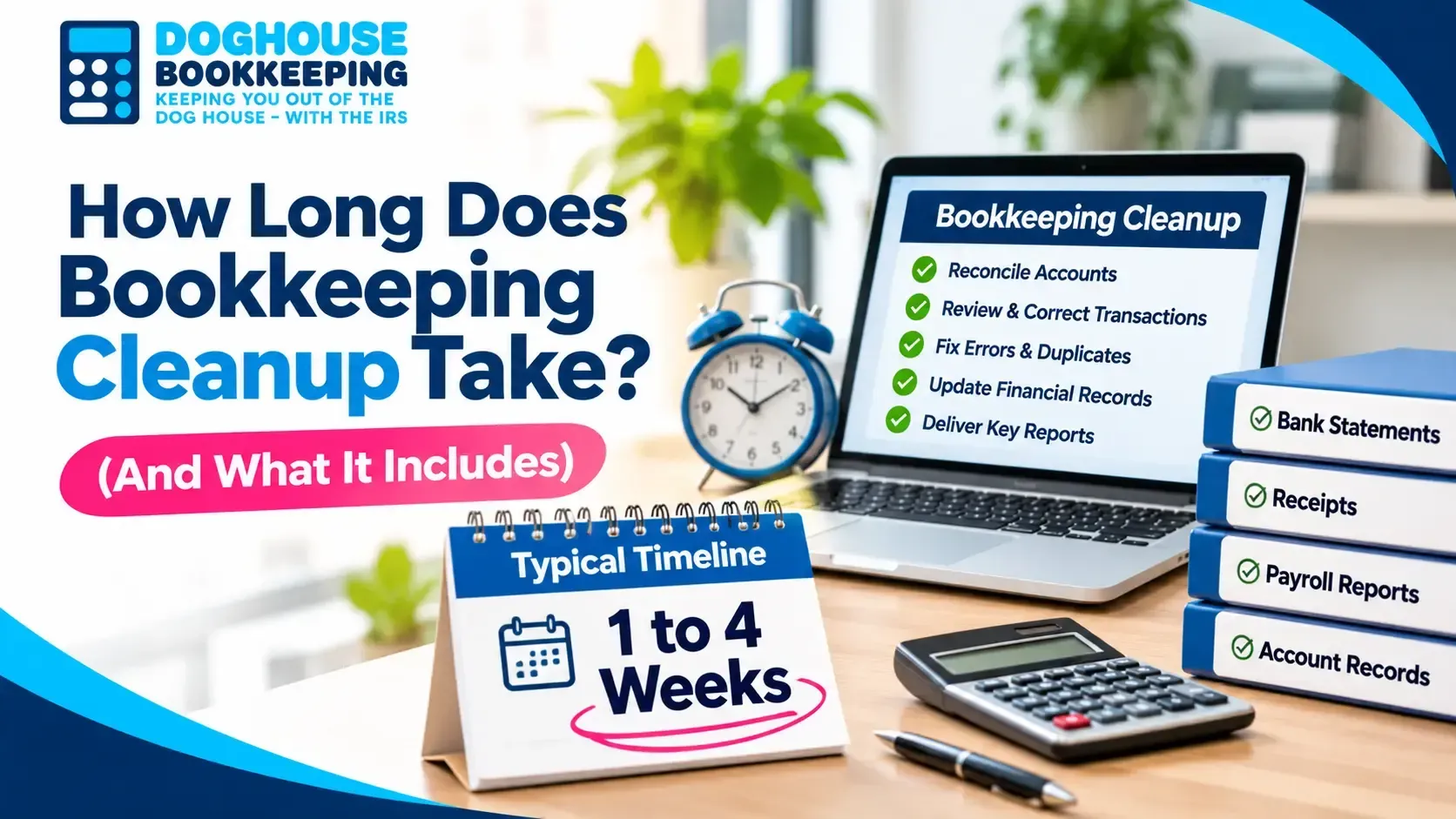
Most bookkeeping cleanup projects take one to four weeks. A few months of backlog often takes about a week, a full year usually takes two to three weeks, and multi-year or multi-entity cleanups can run longer. The timeline depends on how many months are behind, how many transactions and accounts you have, and how quickly you can provide missing statements and answer questions.
Opening your accounting software and finding numbers you can't trust is stressful, and the first question most owners ask is how long it will take to fix. At Dog House Bookkeeping, we run
bookkeeping cleanup projects for small businesses across Riverside, and the answer is usually shorter than owners expect.
How Long Does Bookkeeping Cleanup Take?
The timeline depends mostly on how far behind your books are. These are typical ranges for a small business with a manageable number of accounts.
| How Far Behind | Typical Timeline |
|---|---|
| 1 to 3 months | A few days to 1 week |
| 4 to 6 months | 1 to 2 weeks |
| 7 to 12 months | 2 to 3 weeks |
| 12 to 24 months | 3 to 5 weeks |
| Multiple years, several entities, or heavy errors | 5 weeks or more, scoped after an assessment |
What Affects How Long Bookkeeping Cleanup Takes?
Six factors decide the timeline:
- Months behind. Every extra month adds transactions to review.
- Transaction volume. A contractor with hundreds of monthly transactions takes longer than a consultant with fifty.
- Number of accounts. Each bank account, credit card, loan, and payment processor needs its own reconciliation.
- Condition of the records. Missing statements, duplicates, and uncategorized transactions slow every step.
- Payroll and sales tax. Payroll liabilities and tax accounts add checks that simpler businesses don't need.
- Your response time. Questions that sit unanswered for a week can stall a project that would otherwise take days.
What Does Bookkeeping Cleanup Include?
Bookkeeping cleanup is a project that corrects and completes your financial records so they are accurate and ready for taxes, lenders, or a sale. A professional cleanup typically includes these steps:
- Assessment. We review your file, find the gaps, and set the scope before any work starts.
- Document gathering. We collect bank statements, credit card statements, loan statements, payroll reports, and receipts for the full period.
- Account reconciliation. Every account is matched to its statements, month by month, starting with the oldest period.
- Transaction review. Uncategorized and miscategorized transactions are reviewed and corrected.
- Error correction. Duplicates, misposted deposits, and transfers recorded as income or expenses are fixed.
- Balance sheet review. Opening balances, loan balances, and leftover clearing accounts are checked.
- Payables and receivables check. Open invoices and unpaid bills are compared against what is really owed.
- Final review and reports. You receive reconciled accounts, a profit and loss statement, and a balance sheet you can rely on.
Bookkeeping Cleanup vs Catch-Up Bookkeeping
These two terms are often used interchangeably, but they describe different problems. Catch-up bookkeeping records months that were never done. Cleanup fixes records that exist but are wrong. Many businesses need both. For example, you may be four months behind and also have two years of miscategorized expenses. We scope them together so you get one clear timeline instead of two.
Signs You Need a Bookkeeping Cleanup
Not sure whether you need a cleanup or just a little organizing? These signs usually point to a cleanup:
- Your bank balance and your books don't match
- Your CPA says your records need work before they can file
- You find duplicate or uncategorized transactions
- You haven't reconciled in several months
- You can't produce a profit and loss statement you trust
How to Make Your Bookkeeping Cleanup Faster
You can cut days off a project with a little preparation:
- Gather your statements first. Collect every bank and credit card statement for the period, or give your bookkeeper bank feed access.
- Share software access. Give access to QuickBooks Online, Xero, Wave, or FreshBooks, so nothing has to be rebuilt from scratch.
- Flag what you already know. Mention personal charges, closed accounts, and transactions you can't identify.
- Answer questions quickly. A one- or two-day reply keeps the work moving.
- Decide the goal. Tell us whether the books are for taxes, a loan, or a sale, so we know how far back to go.
Not sure how far back your cleanup needs to go? Talk to our team, and we'll scope it with you before we start.
What Happens After Your Books Are Cleaned Up?
Cleanup fixes the past. Ongoing bookkeeping keeps it from happening again. Once you are caught up, most clients move to monthly bookkeeping, so every account is reconciled each month, and reports arrive on schedule.
This is also the best time to share your books with your CPA. Clean, reconciled records mean your accountant spends time on tax planning instead of sorting out errors. If you are unsure which tasks belong to a bookkeeper and which belong to an accountant, our comparison of bookkeeper vs accountant explains the difference.
Frequently Asked Questions About Bookkeeping Cleanup
How long does bookkeeping cleanup take?
Most cleanups take one to four weeks. A few months of backlog usually takes about a week, and a full year usually takes two to three weeks. Multi-year cleanups or businesses with several entities can take longer.
How much does bookkeeping cleanup cost?
Prices vary because cost follows the same factors as time, including months behind, transaction volume, number of accounts, and the condition of your records. Most providers quote a fixed fee after a short assessment. Ask for a written scope so you know exactly what is included.
What should I do if my bookkeeping is years behind?
Start by gathering every bank and credit card statement for the period. Then work with a bookkeeper who reconciles from the oldest unreconciled month forward. Years of backlog follow the same process as a few months, just repeated more times.
How far back should a bookkeeping cleanup go?
It depends on the purpose. For taxes, go back to the earliest year you still need to file or amend. For a loan or a sale, the most recent year or two is a common starting point. If you are only getting current, go back to the last time your books matched your bank.
Can I clean up my own bookkeeping?
Yes, if the gap is small, such as one or two months. Once you are several months behind, the time and the risk of missing underlying errors usually make professional help worth it.
Will a cleanup fix my QuickBooks or Xero errors?
Yes. Cleanup corrects duplicates, uncategorized transactions, misposted entries, and unreconciled accounts inside your existing file, so you don't need to switch software.
Get Your Books Back on Track
Messy books are common, and they are fixable. The sooner you start a cleanup, the smaller it is.
Dog House Bookkeeping provides bookkeeping cleanup and monthly bookkeeping for small businesses throughout Riverside, Corona, Moreno Valley, and the greater Inland Empire. Our certified, experienced team works in the software you already use and explains everything in plain language.
Schedule a free consultation to learn how long your cleanup will really take.