
Bank Reconciliation for Small Businesses With Multiple Accounts

To reconcile multiple business accounts, reconcile each bank account, credit card, loan account, and payment processor against its corresponding statement or transaction records. Verify transfers between accounts, investigate discrepancies, and follow a consistent monthly schedule. Once the accounts are reconciled, review the balances to understand your available cash and outstanding liabilities.
Very few small businesses stay with a single bank account for long. A second account gets opened for payroll, another for sales tax or taxes in general, a savings account for reserves, a card for purchases, and a payment processor that collects customer payments before they ever reach the bank. Each one makes sense on its own. Together, they create a reconciliation workload that's easy to underestimate. At Dog House Bookkeeping, we reconcile every account a business uses as part of our Bank reconciliation services.
Why Multiple Accounts Make Reconciliation Harder
With one account, reconciliation is a single comparison. With five, it's five comparisons plus the movement between them. Each additional account adds three things that can go wrong:
- Another statement to collect, which may arrive on a different date than the others
- Another set of transactions to match, often with different descriptions and formats
- Another set of transfers, since money moving between your own accounts shows up on both sides
The accounts themselves usually aren't the problem. The problem is that nobody has one clear view of all of them at once. An account that gets reconciled every month alongside the others stays accurate. An account that's reconciled "when there's time" drifts, and the drift shows up later as numbers that don't add up.
Common Business Accounts That Need Reconciling
Most small businesses with more than one account have a mix of these:
- Operating checking account - the main account for deposits and day-to-day spending
- Payroll account - a separate account that funds paychecks and payroll taxes
- Savings or reserve account - money set aside for taxes, slow months, or equipment
- Sales tax or tax reserve account - funds held aside for tax obligations
- Business credit cards - liabilities that need their own reconciliation
- Payment processors - platforms like Stripe, Square, or PayPal that hold funds before paying them out
- Loans and lines of credit - balances that change through payments, interest, and draws
If you can name an account, and money moves through it, it belongs in the monthly reconciliation.
Not sure whether every account you use is being reconciled? Talk to our team, and we'll map out what needs to be covered.
How to Reconcile Multiple Bank Accounts Step by Step
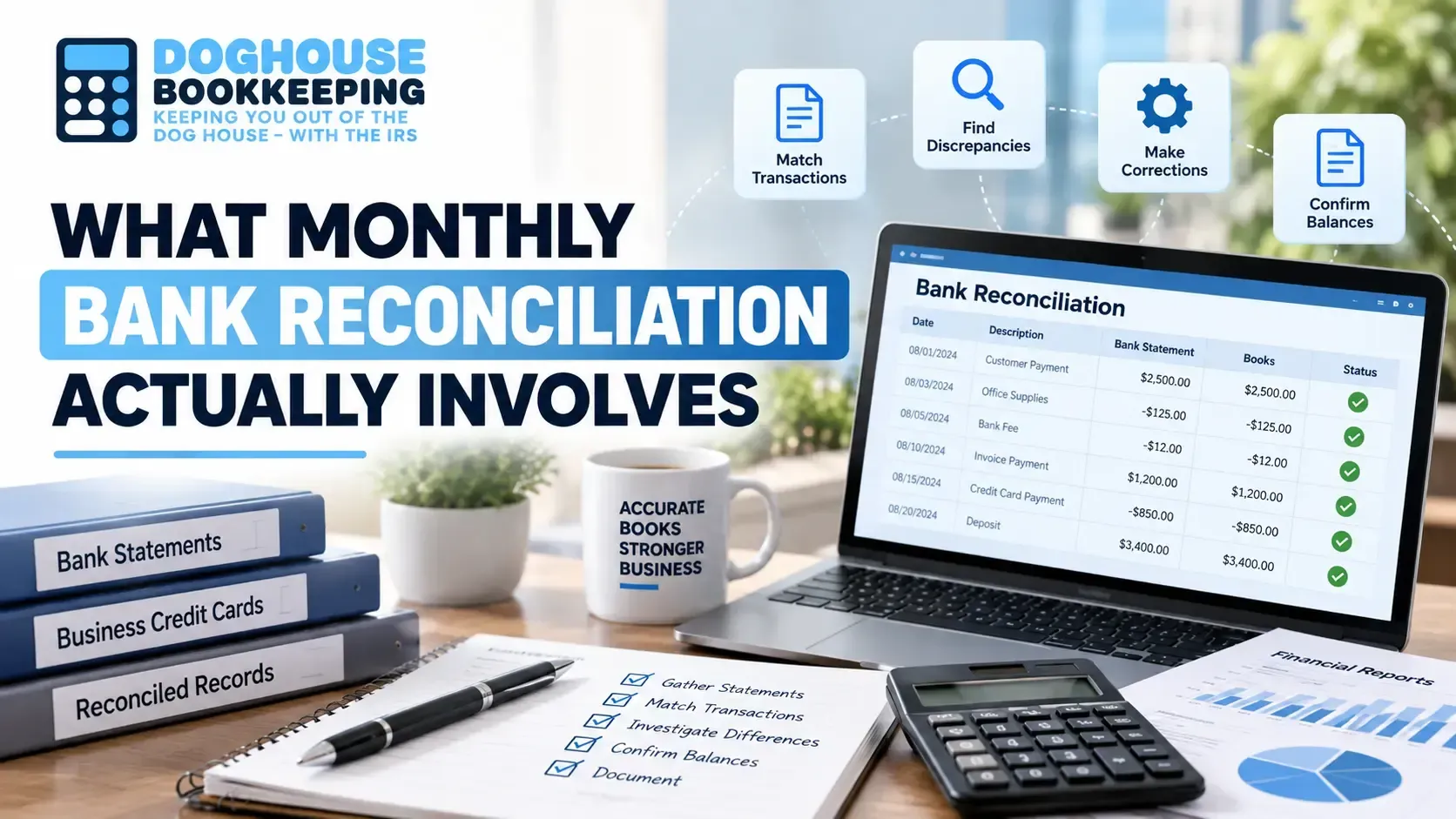
A reliable process treats each account individually first, then checks the connections:
- List every account the business uses, including processors and cards, so none are forgotten
- Collect every statement for the same period at the start of the month
- Reconcile each account separately against its own statement, matching transactions line by line
- Identify transfers between accounts and confirm each one appears on both sides
- Confirm transfers are recorded as transfers, not as income in one account and an expense in the other
- Resolve differences and confirm each ending balance agrees with its statement
- Review the combined position to make sure total cash across all accounts makes sense
Step five is where multi-account businesses most often go wrong, which is covered in the next section.
The Transfer Problem
Moving $5,000 from your operating account to your savings account doesn't change how much money the business has. It only changes where the money sits. But if the withdrawal is recorded as an expense and the deposit is recorded as income, your books will show $5,000 of spending and $5,000 of revenue that never happened.
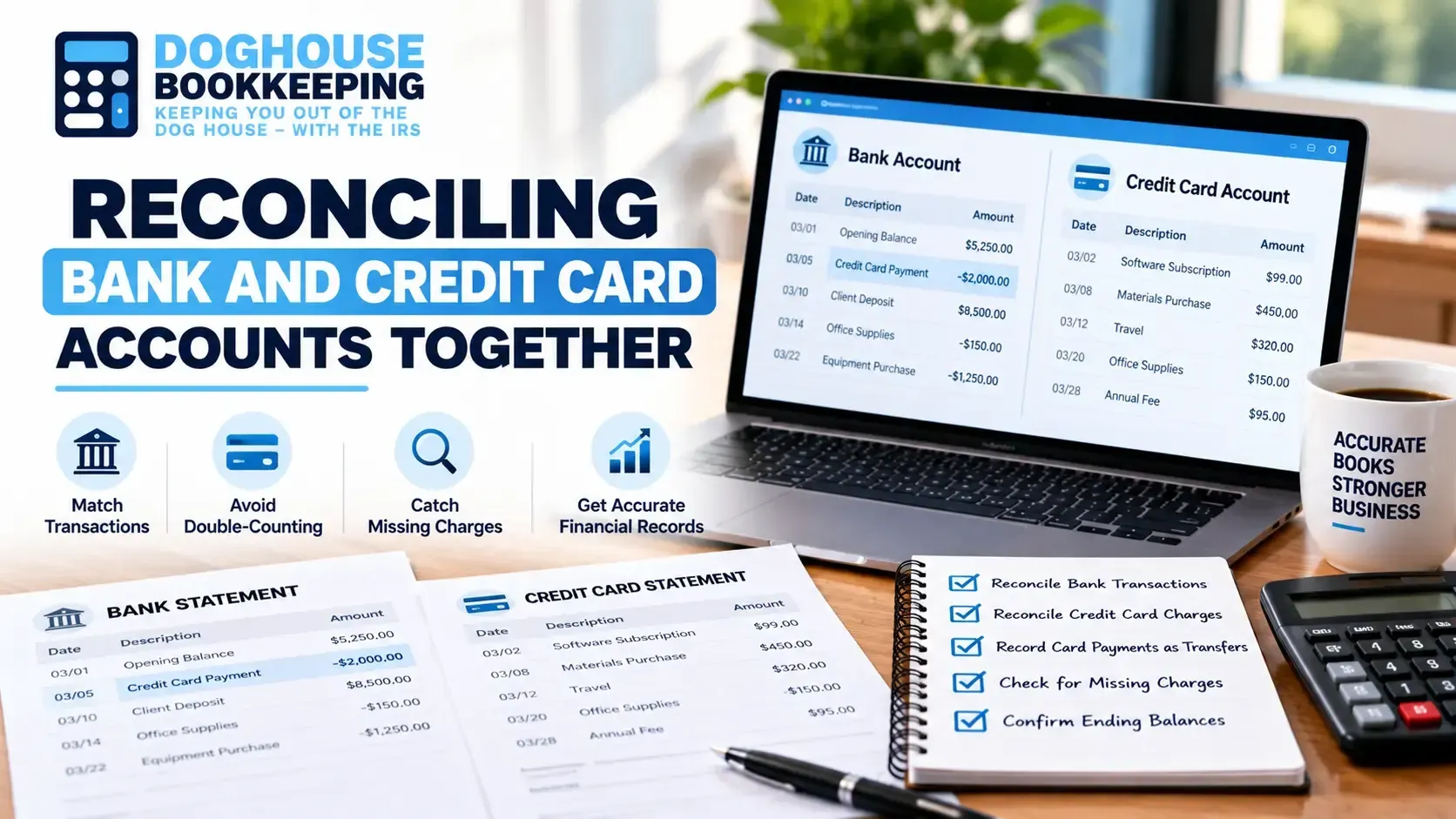
The same principle applies when funding payroll or moving money into a tax reserve. However, credit card payments need separate attention: the payment generally reduces the credit card liability, while the underlying purchases are recorded as expenses. Recording the payment as a new expense can double-count those costs.
A good reconciliation process looks for these pairs deliberately. If a withdrawal from one business account matches a deposit into another account you own, it may be an internal transfer. Check the transaction details and timing before categorizing it, as transfers can post on different dates.
Payment Processors and Net Deposits
Reconcile payment processor activity with the related sales, fees, refunds, and payouts. Depending on how the accounting system is set up, a clearing account can help track the difference between the original transactions and the net deposits received in the bank.
If you only record the deposit that hits the bank, your revenue is understated, and your processing fees never appear as an expense. Reconciling the processor account itself, not just the bank deposits it produces, shows the full sales amount, the fees taken, and the net payout, so each piece lands in the right place in your books.
Warning Signs Your Multiple Accounts Are Out of Sync
- Your income looks higher than your sales, or your expenses look higher than your spending.
- You have an account you rarely look at and haven't reconciled in months
- Savings or reserve balances in your books don't match the bank
- Payment processor deposits don't line up with your recorded sales
- You can't say with confidence what your total cash on hand is
If several of these sound familiar, one or more accounts have probably drifted. The fix is easier the sooner it's tackled, and it's usually a matter of working through the oldest unreconciled month first, then moving forward.
Frequently Asked Questions
How often should I reconcile multiple business accounts?
Monthly reconciliation is a practical baseline for most small businesses. Reconcile each account against its corresponding statement, investigate discrepancies, and verify transfers between accounts. Businesses with high transaction volumes or frequent payouts may benefit from more frequent checks.
Do I need to reconcile a savings account that rarely has activity?
Yes. Even a quiet account can have interest, fees, or transfers that need to be recorded. It also takes very little time when it's done every month.
Should I reduce the number of accounts to make reconciliation easier?
Sometimes. Separate accounts can be useful for payroll, taxes, and reserves, but each one adds work. If an account no longer serves a clear purpose, closing it and simplifying the books is a reasonable choice.
How are transfers between my own accounts recorded?
As transfers, not income or expenses. A transfer moves money between accounts you own and doesn't affect profit. Recording it as income and expense overstates both.
Can one person reconcile all of these accounts?
Yes, and it's usually better than splitting the work. When one person reviews every account in a single pass, transfers and timing differences are much easier to spot.
Keep Every Account in Agreement
More accounts mean more places for errors to hide, but a consistent reconciliation process can help keep your financial records accurate and your cash position clear.
Dog House Bookkeeping provides monthly bookkeeping and reconciliation support to help small businesses keep their financial records organized and review account balances with greater confidence.
Schedule a free consultation and find out whether every account you use is actually agreeing with your books.